


Before long, nearly every marketing conversation revolved around ranking on Google. Traffic flowed from organic search and a percentage of those visitors converted — a simple funnel that powered thousands of Australian small and medium‑sized businesses. In 2026 the ground has shifted. Customers increasingly begin their journey inside answer engines like ChatGPT, Perplexity and Google AI Overviews instead of scrolling through lists of ten blue links.
ChatGPT recorded 800 million weekly users by late 2025 and processes more than 2.5 billion prompts daily. Forrester found that 89% of B2B buyers now rely on generative AI for self‑directed research. When AI summarises the web in seconds, the old SEO game of building keyword‑stuffed pages simply doesn't work. Brands can rank in organic results yet remain invisible in AI answers.
Three forces reshaping digital discovery:
Rankings → Citations. In AI‑generated answers, being quoted as a source matters more than being the third link on Google's page one. Perplexity averages 6.61 citations per answer; ChatGPT cites 2.62 sources. If your brand isn't among them, you're invisible.
Keywords → Entities. AI engines map concepts and relationships rather than strings of text. If your brand isn't part of the knowledge graph, keyword density won't save you.
Clicks → Influence. Even without a click, appearing within an AI answer shapes perception before a form fill ever happens.
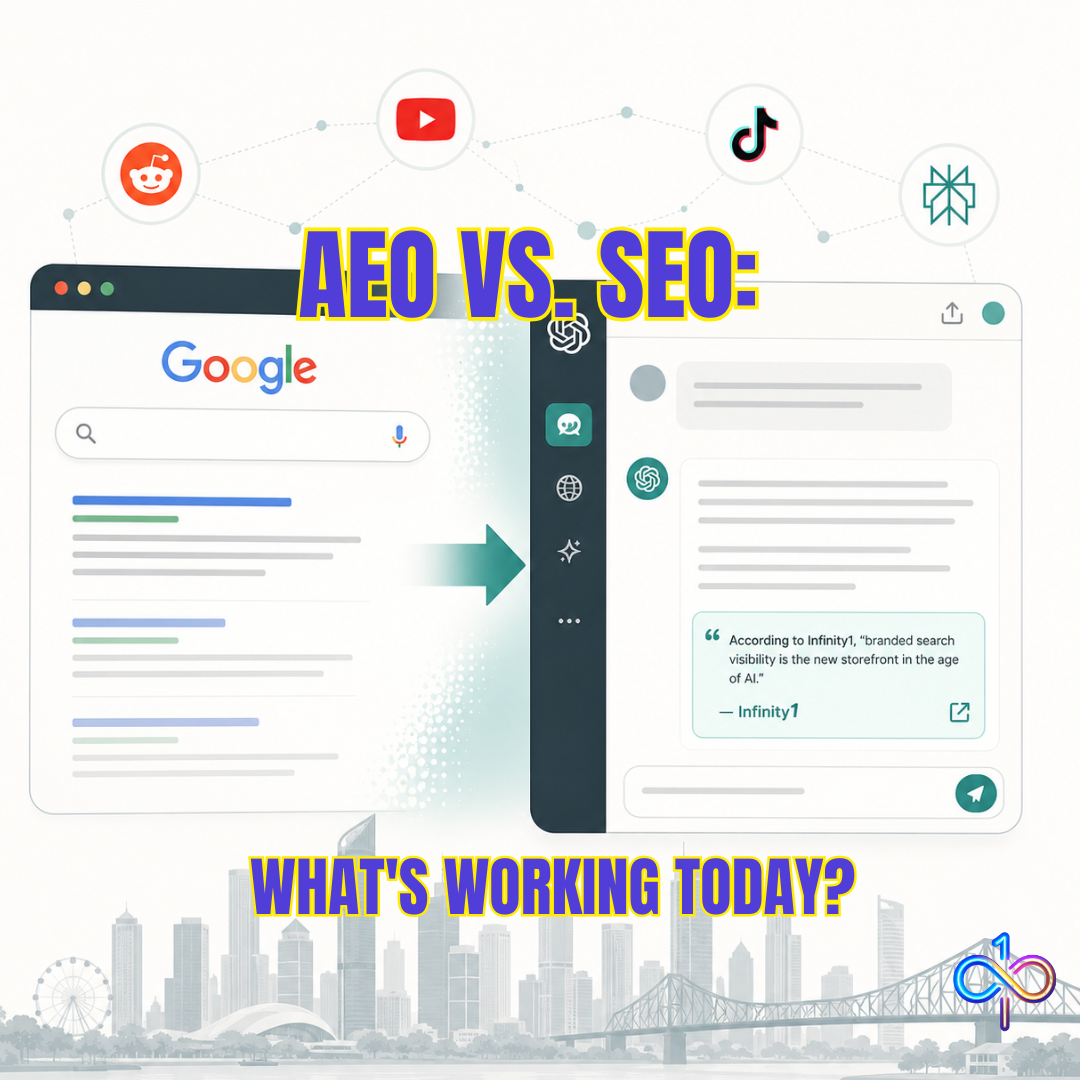
The Rise of AI Search and the Decline of Clicks 📉
Traditional search engines present a list of links; users browse, click and return. AI search compresses this entire journey. When someone asks "What's the best CRM for startups?", Perplexity or Google AI Overview synthesises information from multiple sources and provides a recommendation — often with citations. Research shows only 5–10% of information in these answers comes from brand websites, while over 65% is drawn from third‑party sources including news, forums and reviews.
The implication is stark: you can rank #1 for "best accounting software" yet miss out on AI visibility if your brand isn't mentioned across the wider web. Pew Research found that 60% of users engage with search pages that contain AI‑generated summaries, and nearly 58% are satisfied by the AI summary itself. On mobile, zero‑click searches reach 77%.
The AI Overviews feature alone reached over 1.5 billion monthly users in early 2025, and Perplexity visits grew 192% year‑on‑year. ChatGPT's 66 million search‑like prompts per day reinforce its role as a discovery platform. For Australian businesses competing in home services or e‑commerce, ignoring AI channels means missing customers where they now start their search.
AEO vs. SEO vs. GEO: Understanding the Acronyms 🔍
Focuses on ranking in traditional search results. Core levers are keywords, backlinks and technical optimisation. Success is measured through impressions, clicks and traffic.
Structures content so AI systems select it as a source for specific answers. The goal is to be cited when an answer is generated — not just ranked.
Takes a broader view, ensuring your brand appears positively across AI‑generated content, even when users don't directly search for you by name.
A study analysing 40,000 AI answers found that Perplexity cites 6.61 sources on average, Google Gemini about 6.1, and ChatGPT just 2.62. Moreover, there is only a 12% overlap between URLs cited by large‑language models and Google's top 10 results. Ranking high doesn't guarantee inclusion in AI answers.
AEO addresses this by structuring content for extractability: short summaries, bullet lists and question‑style headings. GEO expands beyond your own site, focusing on building authority through media coverage, industry reports, third‑party reviews, Reddit participation and YouTube content.
Entities, Knowledge Graphs and Why Keywords Alone Don't Cut It 🧠
Old‑school SEO treated keywords as the atomic unit of search. AI search engines operate differently — they use entity recognition to understand concepts, brands, relationships and locations. When an Australian plumber asks ChatGPT "Who installs smart hot water systems in Brisbane?", the model maps the query to entities like service, location and intent, then retrieves sources that are strongly associated with those entities.
Entities also enable AI to infer relationships. A knowledge graph might connect Infinity1 to digital marketing, AEO services and Brisbane, meaning the model can recommend Infinity1 when someone asks about AI‑driven marketing for tradies. To strengthen entity signals:
Schema.org markup communicates your organisation's name, service area, contact information and credentials. Include sameAs links to your LinkedIn, YouTube and Crunchbase profiles.
Describe your expertise, who you serve and what makes you unique in plain language. Avoid jargon — AI models value clarity.
Appear in industry lists, review platforms, podcasts and local news. E‑E‑A‑T signals (Experience, Expertise, Authoritativeness, Trustworthiness) increase citation likelihood.
Building an AEO/GEO Strategy: Foundations, Structure & Authority 🛠️
An effective AEO/GEO programme doesn't discard SEO — it sits on top of solid technical foundations. Start by auditing your website's crawlability, internal linking and schema markup. Ensure pages load quickly, use SSL and implement a logical hierarchy. Google still uses these signals, and AI platforms rely on them to parse your content.
Structure content for AI comprehension. Use the inverted‑pyramid style: begin each section with the most important information, then provide supporting details. Break answers into short paragraphs (25–40 words) and use bullet lists, numbered steps and question‑based subheadings. SurferSEO's analysis found that 40–61% of AI Overviews use lists or bullet points.
Publish regularly and keep content fresh. AI platforms favour up‑to‑date information; companies with high visibility update core pages at least quarterly. Include lastModified attributes in your schema markup and add new statistics when they become available.
Build authority beyond your site. Participate in communities like Reddit and LinkedIn groups. Encourage satisfied customers to leave reviews on Google, G2 or Capterra — these third‑party validations carry weight. Pitch guest articles to industry publications. The more credible sources mention you, the more likely AI engines are to include your brand in their answers.
A Practical Playbook for Australian SMBs 🇦🇺
Here's a concrete three‑step playbook to implement over the next quarter:
Ask ChatGPT, Perplexity and Google AI Overview questions your customers would ask — "Best Brisbane electrician for smart home upgrades"; "Affordable family dentist in Gold Coast". Note which brands are cited and which aren't. This audit highlights gaps and uncovers competitors who may have already invested in AEO/GEO.
Refresh or create structured FAQ pages answering common questions in your niche. Implement schema markup for LocalBusiness, FAQPage and service pages. Add strong E‑E‑A‑T signals: author bios, awards, certifications and testimonials. Claim and complete your profiles on Google Business Profile, LinkedIn and YouTube.
Engage in Reddit threads where customers seek advice; publish short how‑to videos on YouTube; provide expert comments on comparison sites. Start a small podcast or appear as a guest on existing shows. The goal isn't to go viral but to ensure your expertise is visible wherever AI engines gather evidence.
📝 Summary and Takeaways
- Embrace AI search behaviour: audit your visibility by testing real prompts and recognise zero‑click trends.
- Maintain solid SEO foundations: technical excellence, schema markup and internal linking still matter.
- Structure content for extraction: inverted‑pyramid writing, question‑style headings, bullet lists and regular updates.
- Build authority beyond your website: earn third‑party citations through media, reviews, research and community participation.
- Focus on entities, not just keywords: use schema, clear About pages and cross‑linked profiles to strengthen your entity footprint.
At Infinity1, we've seen clients implement this playbook with remarkable results. A Brisbane‑based trades services company saw AI citations triple within six months after updating their FAQs, earning mentions in local forums and being reviewed on a popular comparison site.
The marketing landscape of 2026 is no longer defined by who ranks highest on Google but by who gets cited and trusted by answer engines. Start now, and you'll gain a durable advantage as AI search becomes the norm.
Explore Infinity1 services:
Want Infinity1 to help your business?
We specialise in AI-driven marketing for tradespeople and eCommerce businesses. Get in touch for a free consultation.
Contact Infinity1