


Quick Takeaways
- 1A new Neil Patel analysis of 1,000 prompts across ChatGPT, Gemini, Grok and Perplexity found AI engines primarily cite forums, third-party blogs, news content and social platforms — not branded company websites.
- 2Branded websites consistently ranked low as citation sources. The polished services page your team has spent years optimising rarely makes it into an AI answer.
- 3AI engines aren't looking for "official" — they're looking for consensus, discussion and signals that real people are talking about a topic, a product or a business.
- 4The old SEO question was "Can you rank?" The new one is "Does the internet talk about you?" Most Australian businesses can't honestly answer yes.
- 5Winning AI visibility now requires deliberate work across five surfaces: community-led discussion, digital PR, expert-led off-site content, social amplification and third-party reviews.
- 6This isn't a future problem. Your prospects are already asking ChatGPT, Gemini and Perplexity for recommendations every day, and the answer is being shaped by signals you haven't been investing in.
- 7First-mover advantage is genuinely open right now — most Australian competitors aren't doing this yet, and the compounding effect of starting early is significant.
Most Australian Businesses Are Optimising for the Wrong Thing
If your marketing strategy still revolves around publishing blog posts on your own website and waiting for Google to rank them, the data says you're optimising for the wrong surface.
Earlier this month Neil Patel's team at NP Digital published an analysis of 1,000 prompts across the four major AI engines — ChatGPT, Gemini, Grok and Perplexity. The question they asked was simple: when these engines answer a query, where does the answer actually come from? The result was uncomfortable for anyone who has spent the last decade pouring budget into on-site SEO. Branded company websites ranked surprisingly low as citation sources. The bulk of the answers came from forums and user-generated content, third-party blogs, news coverage and social platforms.
At Infinity1 we've been watching this shift play out across our Brisbane and broader Australian client base for months — but seeing it quantified across 1,000 prompts makes it impossible to ignore. The businesses winning AI search visibility aren't the ones with the biggest content libraries or the cleanest websites. They're the ones the internet is genuinely talking about.
Why AI Engines Behave This Way
Large language models — the technology powering ChatGPT, Perplexity, Gemini and the AI Overviews now showing up on Google — are trained, and increasingly grounded at query time, on the open web. When they need to answer a question, they're not looking for the most polished marketing copy. They're looking for consensus. They want signals that lots of different sources, written by lots of different people, are saying the same thing about a topic, a product or an organisation.
That makes a Reddit thread with 40 honest comments more useful to an AI engine than a single immaculate page on your domain. It makes a news article naming your business more authoritative than your "About Us" section. And it makes a customer review on a third-party platform more credible than your own testimonials page — because the engine has no incentive to trust content the business itself controls.
This is the same shift we've been writing about under the "social-first ranking" banner, just viewed from the AI side instead of the Google Search side. Both systems have converged on the same underlying signal: third-party validation now outweighs on-site polish.
The New Question Every Business Should Be Asking
The old SEO question was straightforward. Can you rank? You answered it with a technical audit, a content calendar and a backlink strategy, and the answer was largely controllable.
The new question is different. Does the internet talk about you? That's not something you can solve with a faster website or better meta descriptions. It requires you to behave like a business that's actually worth talking about, and then make sure those conversations are findable in the places AI engines look.
For most Australian businesses, the honest answer to the new question is "not really, and we don't know how to change that." That's not a criticism — it's a strategic gap, and a fixable one. But it requires a rethink of where marketing budget is going, what content is being produced and which surfaces are being prioritised. If 80% of your spend is still aimed at your own domain, you're investing in the surface AI engines look at least.
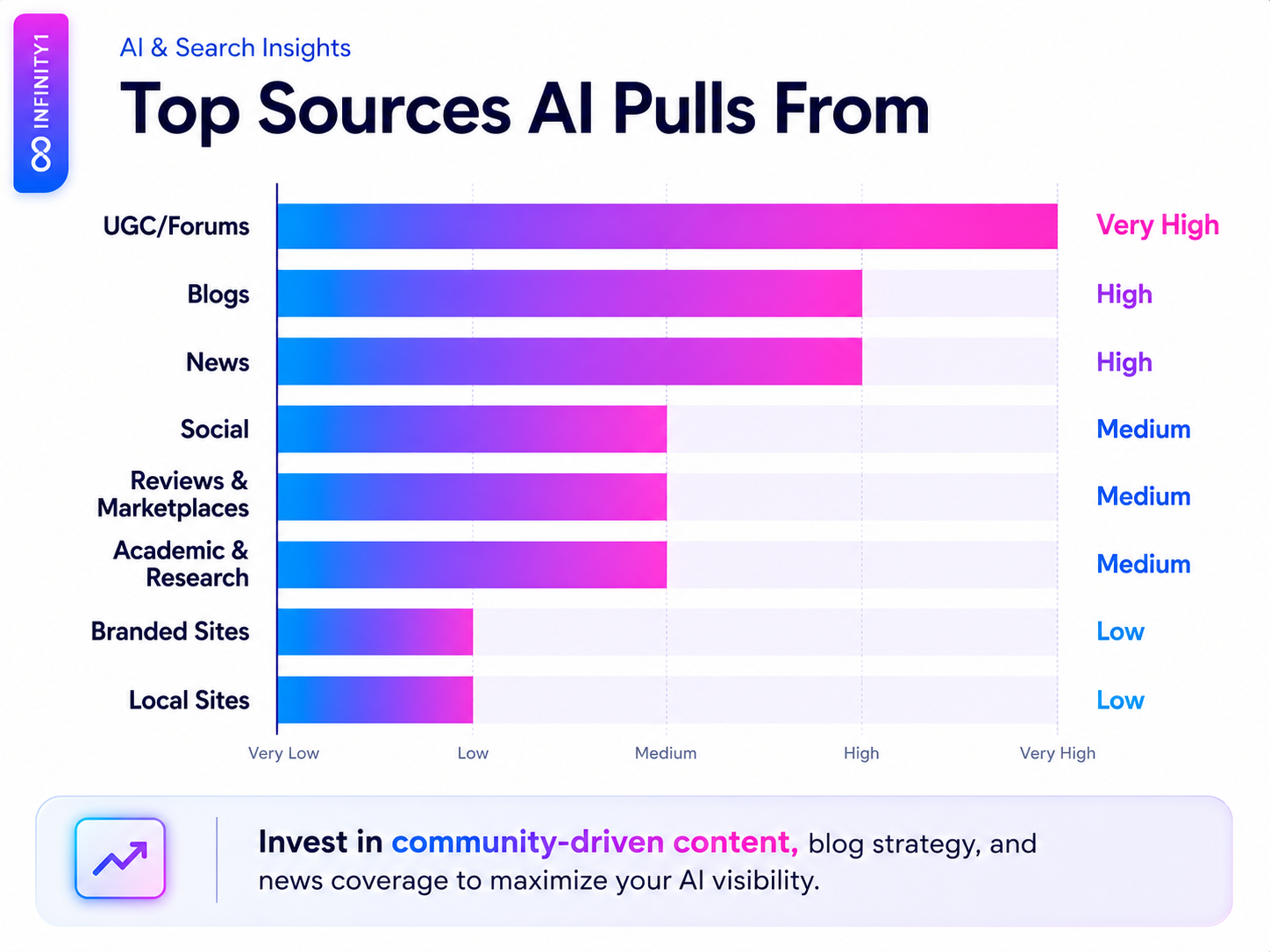
Source: NP Digital analysis of 1,000 AI prompts across ChatGPT, Gemini, Grok and Perplexity
The Five Surfaces That Actually Drive AI Visibility
Based on the NP Digital data and what we're seeing with our own Australian clients, the businesses winning AI search are deliberately investing across five surfaces. None of them are new — what's new is how heavily AI engines now weight them.
Community-led discussion
Reddit, Quora, niche industry forums and local Facebook groups are where AI engines find real conversations. For an Australian tradie that might mean the renovation subreddits or local suburb Facebook groups. For a B2B service provider it might mean LinkedIn comment threads or Slack communities. Showing up authentically — answering questions, contributing without selling, getting mentioned by others — builds the kind of digital footprint AI engines treat as authoritative. The signal isn't "this business posted in the group." It's "real people are discussing this business, and the discussion is positive."
Digital PR and earned media
A mention in a relevant Australian publication — Domain, the Gold Coast Bulletin, an industry newsletter, a podcast in your sector — carries weight no on-site content can replicate. Digital PR is the modern evolution of media relations: pitch journalists with a real story angle, get coverage with a backlink, earn the citation. AI engines treat news coverage as a strong authority signal, and a single well-placed story can generate more long-term value than months of keyword work.
Expert-led content off your own site
Keep publishing on your own domain — but also write for industry publications, contribute to podcasts and let your team's expertise show up where your prospects already trust the source. A guest post in a relevant Australian industry publication, an expert quote in a trade magazine, a podcast appearance — each one is a citation source AI engines can pull from when forming an answer.
Social distribution and amplification
Posts that get genuine engagement on LinkedIn, conversations on X, comments on YouTube — these are signals AI engines factor in. Distribution isn't just for awareness anymore. A well-engaged LinkedIn article is increasingly more visible in AI search than the same content sitting on your website with no social signals attached.
Reviews and third-party validation
Google reviews, Productreview.com.au, industry-specific review platforms — every authentic review is a citation source for an AI engine deciding whether to mention your business. The brands winning here are the ones with consistent, recent, detailed reviews across multiple platforms. Not just five-star averages, but specific reviews that describe real outcomes in the customer's own words.
How to Start Without Burning Yourself Out
The five-surface approach can sound overwhelming, especially for a small or mid-sized Australian business that doesn't have a marketing team. The good news is you don't have to attack all five at once. The businesses we see winning have started narrow and built consistency before broadening.
A practical first quarter looks like this. Pick the one community where your customers genuinely spend time — usually a subreddit, a specific Facebook group or LinkedIn — and commit to 20 minutes of authentic participation three times a week. Identify two or three local Australian publications or industry blogs that cover your sector, and develop one story angle worth pitching them this quarter. Audit your review platforms and put a simple system in place to ask happy customers for a detailed review (not just a star rating). Pick one team member to be the content coordinator, even if it's only a few hours a week.
That's it for the first 90 days. After three months you'll have evidence of what's working in your specific market, and you can broaden from there.
For businesses that want to move faster, Billy Bots — our AI automation platform — can handle the parts of this work that don't require your strategic input. Drafting case study outlines after every job, monitoring brand mentions across the web, surfacing review opportunities, scheduling social distribution of your content — these are all parts of the process where automation creates capacity without diluting authenticity. The human judgment stays with you. The repetitive execution runs in the background.
The Time to Start Is Now
Let's revisit what this means for your business.
First, the data is in. AI engines aren't citing your website — they're citing the conversations, content and coverage that exist about your business across the rest of the internet. Continuing to spend the bulk of your marketing budget on on-site optimisation is investing in the surface AI engines look at least.
Second, the new ranking question — does the internet talk about you? — requires a deliberate strategy across five surfaces: community participation, digital PR, off-site expert content, social amplification, and third-party reviews. None of these are new, but the algorithmic weight on each has shifted dramatically over the past two years.
Third, first-mover advantage in this space is genuinely open right now. Most Australian businesses are still operating on the old SEO playbook. The ones that start building authority across the new surfaces now will compound that advantage for years before competitors catch up.
If your current marketing plan doesn't have a deliberate strategy for being mentioned, reviewed, discussed and cited beyond your own website, you're already invisible in the new search — and the gap widens every month.
Book a strategy call with Infinity1 and we'll map out exactly where your business currently shows up across the major AI engines, where you're being left out, and the smallest set of moves that will start changing those results. Whether you want Billy Bots to automate the execution layer or a full social-first strategy designed for your trade and location, we'll show you what the first 90 days should look like. The sooner you start, the sooner the compounding begins.
Explore Infinity1 services:
Want Infinity1 to help your business?
We specialise in AI-driven marketing for tradespeople and eCommerce businesses. Get in touch for a free consultation.
Contact Infinity1